The Thousand-Dollar Heartbeat
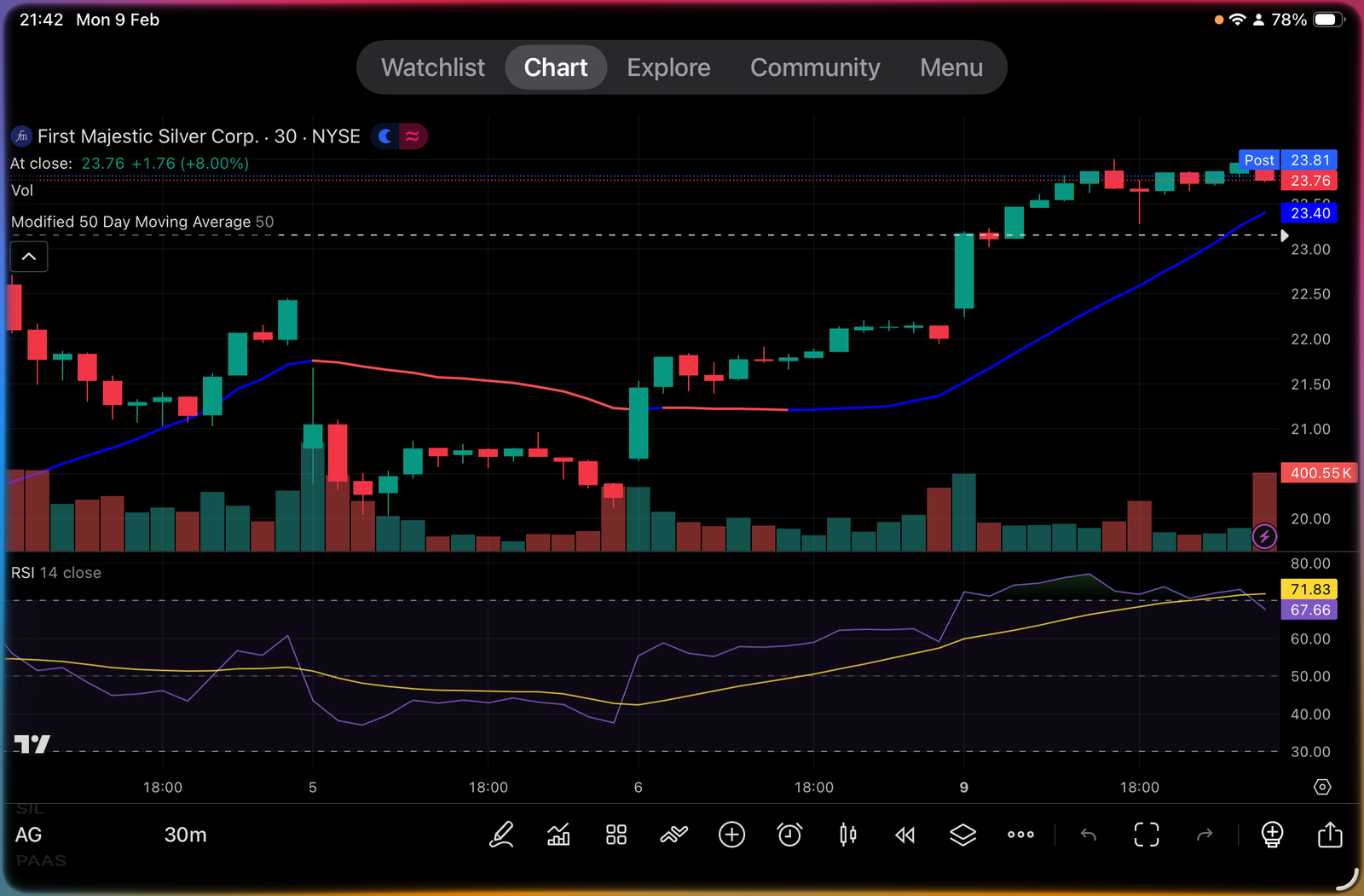
They say you never forget your first real trade. I certainly won’t. I decided to move beyond the “paper trading” phase and invested $1,000 of my hard-earned money in First Majestic Silver (AG).
When I noticed the price dropping to $23.67, my heart raced. In that moment, I realized that if I didn’t control my breathing, the market would control me.
I used a technique I’ve practiced for years: Box Breathing.
By taking four seconds to inhale, four seconds to hold, and four seconds to exhale, I forced my nervous system to calm down.
I wasn’t just a trader anymore; I was a practitioner of Omstock. I stopped reacting to the red candles and started responding to my strategy.
This is the “Mind Control” I plan to teach—because the biggest obstacle in any trade isn’t the stock; it’s the person behind the screen.
Up until that moment, numbers on a screen felt like a game. But the second I hit “Buy,” something shifted. I felt it in my chest—a physical reaction. Suddenly, every tick of the price wasn’t just data; it was my money.
When the “Snow” Turned Red
I was watching the charts, and everything looked green. I was up about $22—not a significant amount, but a win nonetheless.
Then, the market did what it does best: it changed.
I saw a red candle with a long “fuse” (upper wick) pointing straight up. To me, it looked like a warning.
The price dropped from $23.80 to $23.67 in an instant. That’s when the “Day Trader Panic” started to set in. My instinct was to run, but my Mentor stepped in to help me “read the snow.”
Lesson 1: Mastering the Art of Scaling Out
Instead of panicking and selling everything, my mentor and I discussed a strategic move: Scaling Out.
- The Plan: Sell half of my shares (21 shares) to secure an $11 profit.
- The Psychological Advantage: By securing that $11, I felt like I had “paid for my lunch,” making the remaining shares feel lighter and more manageable.
Lesson 2: The Unexpected “Stop Loss”
This is where the real learning occurred. My mentor advised me to set a Stop Loss at $23.33 (my break-even price) for the remaining shares. I believed this was a prudent safety net.
However, I encountered a technical issue: The shares sold immediately upon submission.
What I discovered: If the market price is already approaching your “Stop Price” when you submit the order, it triggers instantly.
This was a “training wheels” mistake, but it was crucial in teaching me that in a fast-moving market, your safety net needs room to breathe.
The Final Outcome
By the end of the day, I had realized a profit of +€4.48.
While this may not have been the thousands of dollars advertised in “get rich quick” YouTube videos, it was a significant victory. I successfully:
- Navigated a $1,000 position without succumbing to emotional impulses.
- Developed the ability to interpret “Price Rejection” on a 1-minute chart.
- Managed a technical error and still emerged in the green.
My Advice to Aspiring Traders
Trading should never be done alone. Whether it’s with a human mentor or an AI, having someone to provide logical guidance when emotions run high is the difference between gambling and trading.
Leave a Reply